How Thick Should Clay Slabs Be? A Guide to Slab Handbuilding
· Updated · 3 min read
Slab building needs no wheel: you roll clay flat, cut shapes and assemble them. It’s the quickest way for a beginner to make a mug, plate, box or tile that looks deliberate instead of lumpy.
How thick?
- Tiles, ornaments, jewelry: about 1/8 to 3/16 in (3 to 5 mm).
- Mugs, cups, small boxes: about 1/4 in (6 mm).
- Plates and dishes: about 1/4 in (6 mm).
- Large platters and planters: about 5/16 to 3/8 in (8 to 10 mm).
Thin slabs are light and delicate. Thick ones are sturdy but heavy and slow to dry. Most people land on 1/4 in for functional ware. Whichever you pick, keep the whole piece the same thickness.
These are starting points, not rules. Groggy sculpture clays handle thicker slabs, porcelain is often rolled thinner, and a big flat piece needs more thickness than a small curved one. Your clay’s own notes and a test piece or two beat any chart.
Rolling an even slab
Even thickness fixes more slab problems than anything else. A slab that’s thick in places and thin in others dries unevenly and warps or cracks.
- Wedge the clay to get rid of air bubbles.
- Roll on canvas or linen so it doesn’t stick. A natural linen cloth also adds a soft texture if you want it.
- Put a pair of slab rolling guides on each side of the clay and roll until the pin rides on them. Every slab comes out the same. The 8 piece set covers 1/8 to 3/8 in.
- Roll in different directions and flip the slab once or twice.
- Compress both sides with a rib. It aligns the clay and cuts down on warping a lot.
Rolling pins, guides and linen are in slab tools.
Slab tools we recommend
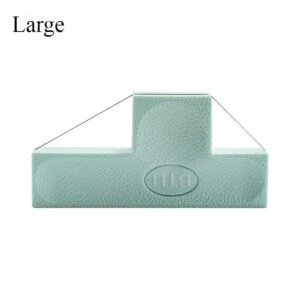
Use it for: Clean 45 degree bevels for strong box corners
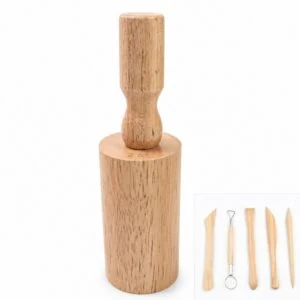
Use it for: Wrapping slab mugs to the same size every time
Skip it if: you're making one or two mugs: a cardboard tube or PVC pipe wrapped in newspaper works as a form
Soft or stiff?
How long you let a slab firm up depends on what you’re making. Soft slabs, used soon after rolling, bend easily, so they suit curved forms you wrap or drape, like mugs around a form or bowls over a mold. Stiff slabs, firmed to soft leather hard, hold their shape. Use those for boxes, planters and anything with straight walls and corners.
Cutting
Let a fresh slab firm up a little before you cut it, because soft clay drags and distorts. Use a sharp knife or fettling knife against a ruler for straight edges, and cutters for circles, squares and repeated shapes. Round ring cutters are handy for mug bases and lids. Browse clay cutters.
Joins
Joins are where slab pieces fail.
- Bevel the edges at 45 degrees where two walls meet. A bevel cutter gives you consistent 30, 45 and 60 degree angles.
- Score both surfaces with a needle tool, serrated rib or scoring brush.
- Add slip (clay thinned with water) to both scored edges.
- Press the pieces together firmly, then reinforce the inside seam with a thin coil and smooth it with a rib or modeling tool.
Molds and forms
Molds help with curves. Hump molds are domes: drape a slab over the top for bowls and dishes. Try the wooden hump molds with handle or a hemisphere hump mold. Slump molds are hollows, and you press a slab inside for plates and trays. For mugs and cups, wrap a slab around a wooden cup forming mold and every one comes out the same size.
Dust molds with cornstarch or cover them with thin cloth so the clay lets go, and take pieces off at soft leather hard, before the clay shrinks onto the mold. Browse molds and forms.
Texture
Slabs take texture well. Roll a texture roller or press stamps in before you cut, so the pattern runs evenly across the piece. See texture and stencils.
Drying without warping
Dry slab pieces slowly, loosely covered with plastic. Plates and tiles stay flat between boards, on drywall or on a fiberboard drying bat. Flip flat pieces now and then so both sides dry at the same rate.
Just starting out? See the pottery tools beginners actually need, and which rib to use for compressing slabs.
Questions potters ask
Why do my clay slabs warp?
Uneven thickness, clay that wasn't compressed, or uneven drying. Roll with guides, compress both sides with a rib, and dry slowly under loose plastic, flipping flat pieces so both sides dry at the same rate.
Do I need a slab roller?
No. A rolling pin and a pair of slab rolling guides make even slabs for mugs, plates and tiles. A slab roller saves time and effort on big slabs or production work, but you don't need one to start.
How long should a slab dry before I build with it?
It depends on the form. Use soft slabs, within an hour or so of rolling, for wrapping and draping curves. For boxes and straight walls that have to stand up on their own, let slabs firm to soft leather hard, often a few hours.
What is the difference between a hump mold and a slump mold?
A hump mold is a dome. You drape the slab over the outside, so it shapes the inside of a bowl. A slump mold is a hollow. You press the slab inside it, which suits plates and shallow trays.
Can I use any clay for slab building?
Most stoneware and earthenware clays work. Clay with some grog (pre-fired sand) is easier for beginners, because it holds its shape, dries more evenly and warps less than very smooth clay.